What Is a Lip Flip? The No-Filler Guide With Real Answers
Procedure Everyone Keeps Asking About
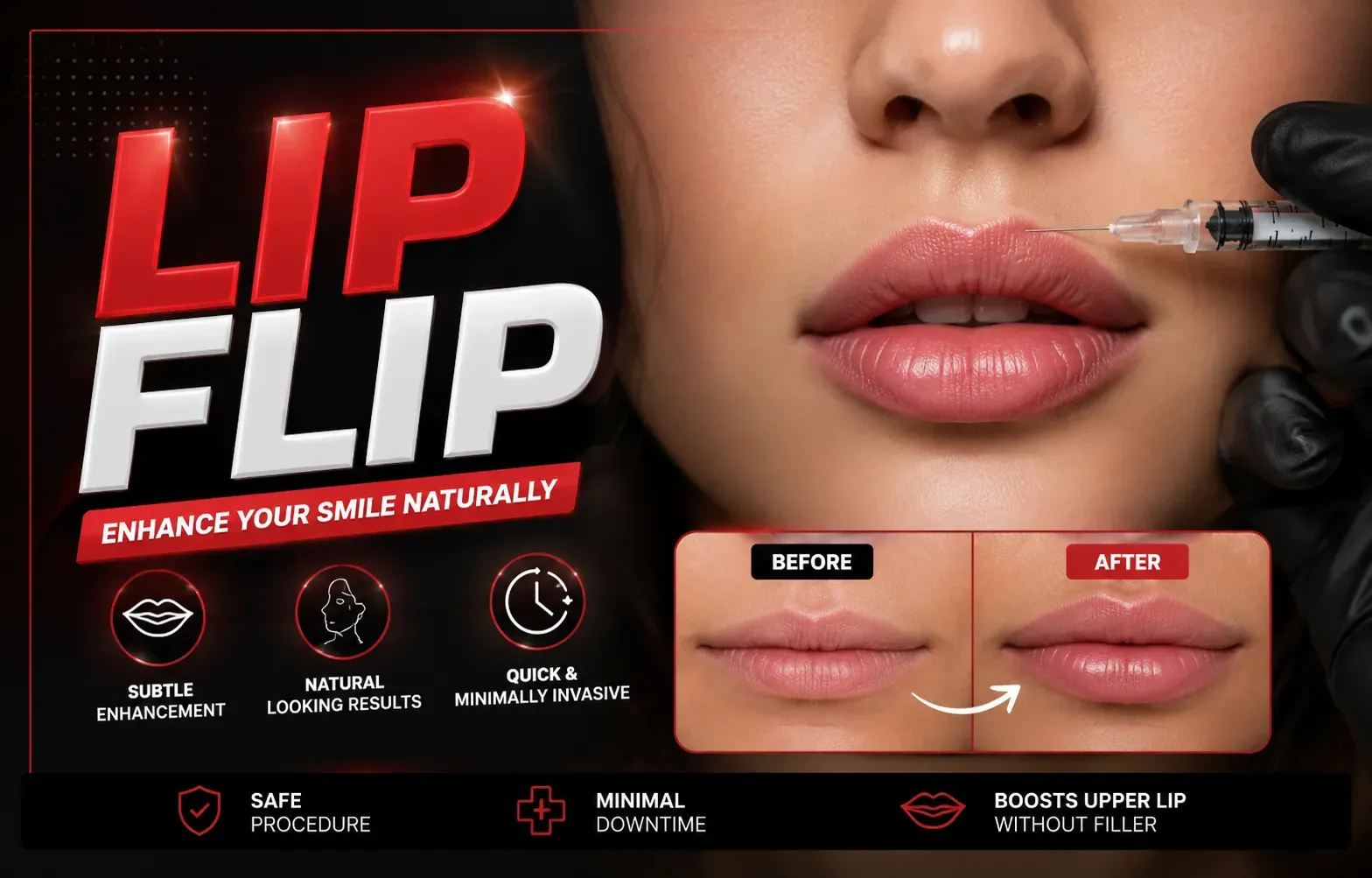
You catch your reflection on a Zoom call and notice your upper lip has nearly vanished when you smile. That thin line where a lip used to be stares back at you. A lip flip fixes exactly that frustration — using tiny amounts of botulinum toxin to relax the muscle around your mouth so your upper lip gently rolls outward. No volume. No filler. Just your natural lip, finally visible when you smile.
What Is a Lip Flip? The Straightforward Definition
A lip flip is a quick, non-surgical cosmetic procedure where a provider injects a small dose of botulinum toxin (typically Botox, Dysport, or Xeomin) into the orbicularis oris muscle — the ring of muscle surrounding your lips. When this muscle relaxes, the upper lip rolls slightly upward and outward, creating the appearance of a fuller lip without adding any volume.
Unlike lip filler, which physically adds hyaluronic acid gel into the lip tissue, a lip flip simply adjusts how your existing lip sits at rest and when you smile. Dr. Karan Lal, a board-certified dermatologist practicing in Arizona, describes it as “releasing the curtain so the lip can show.” The procedure takes roughly ten minutes from start to finish and uses only 4 to 10 units of neurotoxin total.
Most people who search “what is a lip flip” have noticed their upper lip disappears when they smile or simply want a subtle enhancement without committing to filler syringes and the associated swelling.
Lip Flip vs. Lip Filler: Understanding the Actual Difference
The confusion between these two procedures runs deep, so let’s clear it up with a direct comparison.
| Feature | Lip Flip | Lip Filler |
| Primary mechanism | Muscle relaxation | Volume addition with hyaluronic acid gel |
| Best for | Gummy smile correction, upper lip that tucks when smiling | Overall volume loss, shape definition, asymmetry |
| Longevity | 8 to 12 weeks | 6 to 18 months depending on formula |
| Typical cost per session | $60 to $150 | $500 to $1,200 per syringe |
| Appointment duration | 10 to 15 minutes | 30 to 60 minutes including numbing |
| Downtime | None to minimal | Swelling and potential bruising for one to three days |
| Injectable used | Botulinum toxin type A | Hyaluronic acid gel (Juvederm, Restylane, etc.) |
| Reversibility | Not reversible but temporary | Dissolvable with hyaluronidase |
Board-certified plastic surgeon Dr. Melissa Doft points out that many patients actually benefit from combining both procedures — filler adds shape and structure while the lip flip fine-tunes movement and prevents the filler from looking stiff when talking or smiling.
Who Makes a Good Candidate for a Lip Flip?
Not every person walking into a med spa qualifies as an ideal candidate. A lip flip works best for specific anatomical situations.
You may benefit from a lip flip if:
- Your upper lip significantly thins out or disappears when you smile
- You show a moderate amount of gum tissue above your front teeth (a gummy smile)
- You want a subtle change without the “done” look that overfilled lips create
- You feel nervous about filler and want to test the waters with something milder
- Your natural lip shape is already decent but lacks that slight outward roll
- You understand the results last only two to three months
A lip flip likely won’t satisfy you if:
- You want dramatic volume and noticeable plumpness
- Your lips have lost significant structure due to aging
- You have a history of neuromuscular disorders
- You are pregnant, nursing, or allergic to albumin (for some brands)
How the Procedure Actually Feels and Works
Most people assume it hurts. It doesn’t — not really. The needle used for a lip flip is tiny, typically a 30- or 32-gauge insulin syringe, and the injection sites sit right at the border of the lip and surrounding skin. You feel a quick pinch at four to six points along the upper lip line, and occasionally two points on the lower lip if your provider treats both. The whole process wraps up before you finish counting backward from twenty.
Providers map out injection points carefully. The American Society of Plastic Surgeons emphasizes that precise placement matters because injecting too low or too deep can affect your ability to drink through a straw, pronounce certain words, or fully close your mouth.
No numbing cream is typically necessary, though some providers offer it for patients who feel anxious about pain.
What Happens During Recovery: Day-by-Day Timeline
Recovery from a lip flip is minimal, but knowing what to expect prevents unnecessary panic when your lip acts strange on day three.
| Timeframe | What to Expect |
| Immediately after | Tiny red dots at injection sites; minor swelling lasting 20 to 30 minutes |
| First 24 hours | No bending over, no heavy exercise, no touching the area, stay upright |
| Days 2 to 3 | You may notice the lip feels slightly “heavy” or different when pronouncing “b” and “p” sounds |
| Days 5 to 7 | The neurotoxin takes full effect; upper lip visibly relaxes and shows more pink tissue |
| Week 2 | Final results settle in; you can fully assess the look |
| Weeks 8 to 12 | Results gradually wear off as the muscle regains normal movement |
The slight speech oddness surprises some patients. Words that require tight lip closure — like “bubble” or “perfect” — may feel a bit loose for about a week. Drinking through a straw also becomes temporarily tricky for some. Neither effect lasts long, and most people adapt within a few days.
Realistic Results: What a Lip Flip Does and Doesn’t Do
Social media photos set unrealistic expectations. A lip flip will not transform thin lips into full, pillowy ones. What it does is far more subtle.
When the orbicularis oris muscle relaxes, the upper lip rolls outward by a millimeter or two, exposing more of the pink mucosal tissue. This creates the optical illusion of a fuller lip. In selfies and smiling photos, that small change photographs beautifully. In person, someone who sees you every day might notice you look refreshed but won’t immediately pinpoint why.
For people with a gummy smile — where more than three millimeters of gum tissue shows above the upper teeth — a lip flip reduces that display by preventing the muscle from pulling the lip too high. This effect, documented in the Journal of Clinical and Aesthetic Dermatology, makes the procedure particularly valuable for those who feel self-conscious about exposing their gums when laughing.
Cost Breakdown by Region and Provider Type
What you pay depends heavily on where you live and who holds the syringe.
| Provider Type | Cost Range (National Average) | Typical Units Used |
| Board-certified dermatologist | $150 to $300 | 6 to 10 units |
| Board-certified plastic surgeon | $200 to $350 | 6 to 10 units |
| Nurse injector at med spa | $80 to $200 | 4 to 8 units |
| Dental office (trained DDS) | $100 to $250 | 6 to 8 units |
Prices climb in major metropolitan areas. New York City and Los Angeles providers often charge $20 to $25 per unit, while smaller cities may run $10 to $14 per unit. Since a lip flip uses so few units, the total cost remains accessible compared to filler — though the temporary nature means you’ll pay again every quarter to maintain results.
Risks and Side Effects You Should Know Before Booking
Every cosmetic procedure carries risk. The lip flip has a strong safety profile, but complications happen when providers lack training or when patients ignore aftercare instructions.
Common and expected side effects:
- Mild swelling and pinpoint bruising at injection sites
- Temporary difficulty drinking through straws or whistling
- Slight heaviness when speaking for the first 5 to 7 days
Rare but more concerning risks:
- Asymmetry if one side takes up the neurotoxin differently than the other
- Drooling due to an inability to fully seal the mouth
- Lip ptosis — a drooping lip — if the injector spreads toxin into surrounding muscles
- Difficulty pronouncing plosive consonants lasting longer than two weeks
The Facial Plastic Surgery Clinics of North America published a review noting that lip flip complications almost always resolve on their own as the neurotoxin wears off, making this one of the lowest-stakes cosmetic procedures available — provided a skilled injector performs it.
What to Ask Your Injector Before Saying Yes
Walking into a consultation prepared changes the outcome. Ask direct questions.
- “How many lip flips have you personally performed?”
- “Which neurotoxin brand do you recommend for my specific lip anatomy, and why?”
- “What happens if I dislike the result — what recourse do I have?”
- “Can you show me before-and-after photos of your actual patients, not just marketing images?”
- “Do you charge per unit or a flat rate? What’s the total I will pay today?”
- “How do you handle touch-ups if I have asymmetry at the two-week mark?”
Providers who dodge questions or rush the consultation send a clear signal to find someone else. The American Board of Cosmetic Surgery recommends verifying board certification and checking state medical board records before booking any injectable treatment.
Lip Flip and the Gummy Smile Connection
The FDA initially approved botulinum toxin for medical conditions like muscle spasms and chronic migraines. Treating a gummy smile falls into the category of expert off-label use — and it works remarkably well.
When the levator labii superioris and other muscles that elevate the upper lip become overactive, they pull the lip too high, exposing excessive gum tissue. Strategic placement of neurotoxin just above the lip border reduces that upward pull. The result: a smile that reveals teeth, not gums.
The American Academy of Facial Esthetics trains dentists and medical professionals specifically on this technique, noting it as one of the highest patient-satisfaction applications of neurotoxin in the lower face.
Why the Lip Flip Appeals to First-Time Cosmetic Patients
Walking into an injectable appointment feels intimidating. The lip flip lowers the barrier. There’s no commitment to visible change lasting a year or more. No dramatic swelling that forces you to cancel social plans. No large sum of money leaving your account in one go.
Board-certified dermatologist Dr. Shereene Idriss refers to the lip flip as a “gateway treatment” — not in a dismissive way, but because it introduces patients to cosmetic enhancement gently. Someone who likes their lip flip result may feel more comfortable exploring filler later. Someone who dislikes it simply waits eight weeks and returns to baseline.
This psychological safety net, combined with the low price point, makes the procedure particularly popular among people in their twenties and early thirties dipping a toe into aesthetic medicine for the first time.
Maintaining Results: What to Expect With Repeated Treatments
Your first lip flip wears off between week eight and week twelve. Some patients notice their lip muscle “remembering” the relaxed state after multiple rounds, leading to slightly longer-lasting results over time. The body does not build antibodies to botulinum toxin at the tiny doses used for this procedure, so efficacy remains consistent across treatments.
The maintenance schedule looks like:
- First treatment: baseline result, wears off at 8 to 12 weeks
- Second treatment: often lasts 10 to 14 weeks
- Third treatment and beyond: many patients stretch to 12 to 16 weeks between appointments
Factors that accelerate wear-off include high-intensity interval training, excessive sun exposure, smoking, and fast metabolic rates. Your injector will adjust dosing based on how quickly your last treatment faded.
The Psychology Behind the Procedure: What Patients Actually Want
Talking to injectors reveals something interesting — most lip flip patients don’t actually want bigger lips. They want their lips to show up in photos. They want to smile without their upper lip vanishing. They want to look like themselves, just a little more defined.
The procedure speaks to a broader shift in aesthetic medicine. Patients increasingly request “undetectable” work — enhancements so subtle that friends notice something looks good but cannot name what changed. The lip flip fits squarely into this trend, delivering a result that reads as fresh rather than altered.
Finding a Qualified Provider: Credentials That Matter
The person wielding the needle determines your outcome far more than the brand of neurotoxin they use. Vet your injector thoroughly.
Minimum credentials to look for:
- Board certification in dermatology, plastic surgery, facial plastic surgery, or dentistry with injectable-specific training
- Active state medical license with no disciplinary actions
- Documented training specifically in perioral neurotoxin techniques
- Membership in the American Society for Dermatologic Surgery, American Society of Plastic Surgeons, or American Academy of Facial Esthetics
Red flags that warrant walking away:
- Prices dramatically below market average
- Reluctance to share before-and-after photos of their own work
- Pressure to book on the same day as your consultation
- Inability to explain which specific muscles they will inject and why
Frequently Asked Questions
What is a lip flip and how long does it last?
A lip flip is a cosmetic procedure using small amounts of botulinum toxin to relax the muscle around your mouth, causing the upper lip to roll slightly outward. Results last between 8 and 12 weeks depending on your metabolism and activity level.
Can you combine a lip flip with lip filler?
Yes, many injectors recommend combining both treatments. The filler adds volume and shape while the lip flip controls how the lip moves when you smile or speak. Schedule them during the same appointment or within a week of each other.
Does a lip flip affect kissing or eating?
During the first few days, your lip may feel different when drinking from a straw or pronouncing certain words. Eating and kissing typically feel normal. Full muscle control returns as the neurotoxin wears off.
How many units of Botox does a typical lip flip require?
Most providers use between 4 and 10 units total, divided among four to six injection points along the upper lip border. Some injectors add two units to the lower lip for balance.
Is the lip flip procedure painful?
Patients describe the sensation as quick pinches lasting less than a second each. The small needle size and shallow injection depth keep discomfort minimal. Numbing cream is rarely necessary but available for those who request it.
What happens if I don’t like my lip flip results?
Since a lip flip uses botulinum toxin and not permanent filler, results naturally fade within 8 to 12 weeks. No reversal agent is needed. Any issues with speech or asymmetry resolve on their own as the muscle activity returns.
Your Next Step: Book a Consultation, Not Just an Appointment
A lip flip seems simple — and technically, it is. But simple does not mean risk-free, and the difference between loving and regretting the result often comes down to the ten-minute conversation before any needle touches your skin.
Schedule a consultation with a board-certified provider who will assess your facial anatomy, watch how your lip moves when you speak and smile, and give you an honest recommendation — even if that recommendation is to skip the lip flip entirely and consider something better suited to your anatomy. Bring reference photos of results you like, ask every question on your mind, and never let anyone pressure you into a same-day treatment before you feel ready.
The best cosmetic work feels like an upgrade, not a transformation. Start there.
Procedure Everyone Keeps Asking About
You catch your reflection on a Zoom call and notice your upper lip has nearly vanished when you smile. That thin line where a lip used to be stares back at you. A lip flip fixes exactly that frustration — using tiny amounts of botulinum toxin to relax the muscle around your mouth so your upper lip gently rolls outward. No volume. No filler. Just your natural lip, finally visible when you smile.
What Is a Lip Flip? The Straightforward Definition
A lip flip is a quick, non-surgical cosmetic procedure where a provider injects a small dose of botulinum toxin (typically Botox, Dysport, or Xeomin) into the orbicularis oris muscle — the ring of muscle surrounding your lips. When this muscle relaxes, the upper lip rolls slightly upward and outward, creating the appearance of a fuller lip without adding any volume.
Unlike lip filler, which physically adds hyaluronic acid gel into the lip tissue, a lip flip simply adjusts how your existing lip sits at rest and when you smile. Dr. Karan Lal, a board-certified dermatologist practicing in Arizona, describes it as “releasing the curtain so the lip can show.” The procedure takes roughly ten minutes from start to finish and uses only 4 to 10 units of neurotoxin total.
Most people who search “what is a lip flip” have noticed their upper lip disappears when they smile or simply want a subtle enhancement without committing to filler syringes and the associated swelling.
Lip Flip vs. Lip Filler: Understanding the Actual Difference
The confusion between these two procedures runs deep, so let’s clear it up with a direct comparison.
| Feature | Lip Flip | Lip Filler |
| Primary mechanism | Muscle relaxation | Volume addition with hyaluronic acid gel |
| Best for | Gummy smile correction, upper lip that tucks when smiling | Overall volume loss, shape definition, asymmetry |
| Longevity | 8 to 12 weeks | 6 to 18 months depending on formula |
| Typical cost per session | $60 to $150 | $500 to $1,200 per syringe |
| Appointment duration | 10 to 15 minutes | 30 to 60 minutes including numbing |
| Downtime | None to minimal | Swelling and potential bruising for one to three days |
| Injectable used | Botulinum toxin type A | Hyaluronic acid gel (Juvederm, Restylane, etc.) |
| Reversibility | Not reversible but temporary | Dissolvable with hyaluronidase |
Board-certified plastic surgeon Dr. Melissa Doft points out that many patients actually benefit from combining both procedures — filler adds shape and structure while the lip flip fine-tunes movement and prevents the filler from looking stiff when talking or smiling.
Who Makes a Good Candidate for a Lip Flip?
Not every person walking into a med spa qualifies as an ideal candidate. A lip flip works best for specific anatomical situations.
You may benefit from a lip flip if:
- Your upper lip significantly thins out or disappears when you smile
- You show a moderate amount of gum tissue above your front teeth (a gummy smile)
- You want a subtle change without the “done” look that overfilled lips create
- You feel nervous about filler and want to test the waters with something milder
- Your natural lip shape is already decent but lacks that slight outward roll
- You understand the results last only two to three months
A lip flip likely won’t satisfy you if:
- You want dramatic volume and noticeable plumpness
- Your lips have lost significant structure due to aging
- You have a history of neuromuscular disorders
- You are pregnant, nursing, or allergic to albumin (for some brands)
How the Procedure Actually Feels and Works
Most people assume it hurts. It doesn’t — not really. The needle used for a lip flip is tiny, typically a 30- or 32-gauge insulin syringe, and the injection sites sit right at the border of the lip and surrounding skin. You feel a quick pinch at four to six points along the upper lip line, and occasionally two points on the lower lip if your provider treats both. The whole process wraps up before you finish counting backward from twenty.
Providers map out injection points carefully. The American Society of Plastic Surgeons emphasizes that precise placement matters because injecting too low or too deep can affect your ability to drink through a straw, pronounce certain words, or fully close your mouth.
No numbing cream is typically necessary, though some providers offer it for patients who feel anxious about pain.
What Happens During Recovery: Day-by-Day Timeline
Recovery from a lip flip is minimal, but knowing what to expect prevents unnecessary panic when your lip acts strange on day three.
| Timeframe | What to Expect |
| Immediately after | Tiny red dots at injection sites; minor swelling lasting 20 to 30 minutes |
| First 24 hours | No bending over, no heavy exercise, no touching the area, stay upright |
| Days 2 to 3 | You may notice the lip feels slightly “heavy” or different when pronouncing “b” and “p” sounds |
| Days 5 to 7 | The neurotoxin takes full effect; upper lip visibly relaxes and shows more pink tissue |
| Week 2 | Final results settle in; you can fully assess the look |
| Weeks 8 to 12 | Results gradually wear off as the muscle regains normal movement |
The slight speech oddness surprises some patients. Words that require tight lip closure — like “bubble” or “perfect” — may feel a bit loose for about a week. Drinking through a straw also becomes temporarily tricky for some. Neither effect lasts long, and most people adapt within a few days.
Realistic Results: What a Lip Flip Does and Doesn’t Do
Social media photos set unrealistic expectations. A lip flip will not transform thin lips into full, pillowy ones. What it does is far more subtle.
When the orbicularis oris muscle relaxes, the upper lip rolls outward by a millimeter or two, exposing more of the pink mucosal tissue. This creates the optical illusion of a fuller lip. In selfies and smiling photos, that small change photographs beautifully. In person, someone who sees you every day might notice you look refreshed but won’t immediately pinpoint why.
For people with a gummy smile — where more than three millimeters of gum tissue shows above the upper teeth — a lip flip reduces that display by preventing the muscle from pulling the lip too high. This effect, documented in the Journal of Clinical and Aesthetic Dermatology, makes the procedure particularly valuable for those who feel self-conscious about exposing their gums when laughing.
Cost Breakdown by Region and Provider Type
What you pay depends heavily on where you live and who holds the syringe.
| Provider Type | Cost Range (National Average) | Typical Units Used |
| Board-certified dermatologist | $150 to $300 | 6 to 10 units |
| Board-certified plastic surgeon | $200 to $350 | 6 to 10 units |
| Nurse injector at med spa | $80 to $200 | 4 to 8 units |
| Dental office (trained DDS) | $100 to $250 | 6 to 8 units |
Prices climb in major metropolitan areas. New York City and Los Angeles providers often charge $20 to $25 per unit, while smaller cities may run $10 to $14 per unit. Since a lip flip uses so few units, the total cost remains accessible compared to filler — though the temporary nature means you’ll pay again every quarter to maintain results.
Risks and Side Effects You Should Know Before Booking
Every cosmetic procedure carries risk. The lip flip has a strong safety profile, but complications happen when providers lack training or when patients ignore aftercare instructions.
Common and expected side effects:
- Mild swelling and pinpoint bruising at injection sites
- Temporary difficulty drinking through straws or whistling
- Slight heaviness when speaking for the first 5 to 7 days
Rare but more concerning risks:
- Asymmetry if one side takes up the neurotoxin differently than the other
- Drooling due to an inability to fully seal the mouth
- Lip ptosis — a drooping lip — if the injector spreads toxin into surrounding muscles
- Difficulty pronouncing plosive consonants lasting longer than two weeks
The Facial Plastic Surgery Clinics of North America published a review noting that lip flip complications almost always resolve on their own as the neurotoxin wears off, making this one of the lowest-stakes cosmetic procedures available — provided a skilled injector performs it.
What to Ask Your Injector Before Saying Yes
Walking into a consultation prepared changes the outcome. Ask direct questions.
- “How many lip flips have you personally performed?”
- “Which neurotoxin brand do you recommend for my specific lip anatomy, and why?”
- “What happens if I dislike the result — what recourse do I have?”
- “Can you show me before-and-after photos of your actual patients, not just marketing images?”
- “Do you charge per unit or a flat rate? What’s the total I will pay today?”
- “How do you handle touch-ups if I have asymmetry at the two-week mark?”
Providers who dodge questions or rush the consultation send a clear signal to find someone else. The American Board of Cosmetic Surgery recommends verifying board certification and checking state medical board records before booking any injectable treatment.
Lip Flip and the Gummy Smile Connection
The FDA initially approved botulinum toxin for medical conditions like muscle spasms and chronic migraines. Treating a gummy smile falls into the category of expert off-label use — and it works remarkably well.
When the levator labii superioris and other muscles that elevate the upper lip become overactive, they pull the lip too high, exposing excessive gum tissue. Strategic placement of neurotoxin just above the lip border reduces that upward pull. The result: a smile that reveals teeth, not gums.
The American Academy of Facial Esthetics trains dentists and medical professionals specifically on this technique, noting it as one of the highest patient-satisfaction applications of neurotoxin in the lower face.
Why the Lip Flip Appeals to First-Time Cosmetic Patients
Walking into an injectable appointment feels intimidating. The lip flip lowers the barrier. There’s no commitment to visible change lasting a year or more. No dramatic swelling that forces you to cancel social plans. No large sum of money leaving your account in one go.
Board-certified dermatologist Dr. Shereene Idriss refers to the lip flip as a “gateway treatment” — not in a dismissive way, but because it introduces patients to cosmetic enhancement gently. Someone who likes their lip flip result may feel more comfortable exploring filler later. Someone who dislikes it simply waits eight weeks and returns to baseline.
This psychological safety net, combined with the low price point, makes the procedure particularly popular among people in their twenties and early thirties dipping a toe into aesthetic medicine for the first time.
Maintaining Results: What to Expect With Repeated Treatments
Your first lip flip wears off between week eight and week twelve. Some patients notice their lip muscle “remembering” the relaxed state after multiple rounds, leading to slightly longer-lasting results over time. The body does not build antibodies to botulinum toxin at the tiny doses used for this procedure, so efficacy remains consistent across treatments.
The maintenance schedule looks like:
- First treatment: baseline result, wears off at 8 to 12 weeks
- Second treatment: often lasts 10 to 14 weeks
- Third treatment and beyond: many patients stretch to 12 to 16 weeks between appointments
Factors that accelerate wear-off include high-intensity interval training, excessive sun exposure, smoking, and fast metabolic rates. Your injector will adjust dosing based on how quickly your last treatment faded.
The Psychology Behind the Procedure: What Patients Actually Want
Talking to injectors reveals something interesting — most lip flip patients don’t actually want bigger lips. They want their lips to show up in photos. They want to smile without their upper lip vanishing. They want to look like themselves, just a little more defined.
The procedure speaks to a broader shift in aesthetic medicine. Patients increasingly request “undetectable” work — enhancements so subtle that friends notice something looks good but cannot name what changed. The lip flip fits squarely into this trend, delivering a result that reads as fresh rather than altered.
Finding a Qualified Provider: Credentials That Matter
The person wielding the needle determines your outcome far more than the brand of neurotoxin they use. Vet your injector thoroughly.
Minimum credentials to look for:
- Board certification in dermatology, plastic surgery, facial plastic surgery, or dentistry with injectable-specific training
- Active state medical license with no disciplinary actions
- Documented training specifically in perioral neurotoxin techniques
- Membership in the American Society for Dermatologic Surgery, American Society of Plastic Surgeons, or American Academy of Facial Esthetics
Red flags that warrant walking away:
- Prices dramatically below market average
- Reluctance to share before-and-after photos of their own work
- Pressure to book on the same day as your consultation
- Inability to explain which specific muscles they will inject and why
Frequently Asked Questions
What is a lip flip and how long does it last?
A lip flip is a cosmetic procedure using small amounts of botulinum toxin to relax the muscle around your mouth, causing the upper lip to roll slightly outward. Results last between 8 and 12 weeks depending on your metabolism and activity level.
Can you combine a lip flip with lip filler?
Yes, many injectors recommend combining both treatments. The filler adds volume and shape while the lip flip controls how the lip moves when you smile or speak. Schedule them during the same appointment or within a week of each other.
Does a lip flip affect kissing or eating?
During the first few days, your lip may feel different when drinking from a straw or pronouncing certain words. Eating and kissing typically feel normal. Full muscle control returns as the neurotoxin wears off.
How many units of Botox does a typical lip flip require?
Most providers use between 4 and 10 units total, divided among four to six injection points along the upper lip border. Some injectors add two units to the lower lip for balance.
Is the lip flip procedure painful?
Patients describe the sensation as quick pinches lasting less than a second each. The small needle size and shallow injection depth keep discomfort minimal. Numbing cream is rarely necessary but available for those who request it.
What happens if I don’t like my lip flip results?
Since a lip flip uses botulinum toxin and not permanent filler, results naturally fade within 8 to 12 weeks. No reversal agent is needed. Any issues with speech or asymmetry resolve on their own as the muscle activity returns.
Your Next Step: Book a Consultation, Not Just an Appointment
A lip flip seems simple — and technically, it is. But simple does not mean risk-free, and the difference between loving and regretting the result often comes down to the ten-minute conversation before any needle touches your skin.
Schedule a consultation with a board-certified provider who will assess your facial anatomy, watch how your lip moves when you speak and smile, and give you an honest recommendation — even if that recommendation is to skip the lip flip entirely and consider something better suited to your anatomy. Bring reference photos of results you like, ask every question on your mind, and never let anyone pressure you into a same-day treatment before you feel ready.
The best cosmetic work feels like an upgrade, not a transformation. Start there.