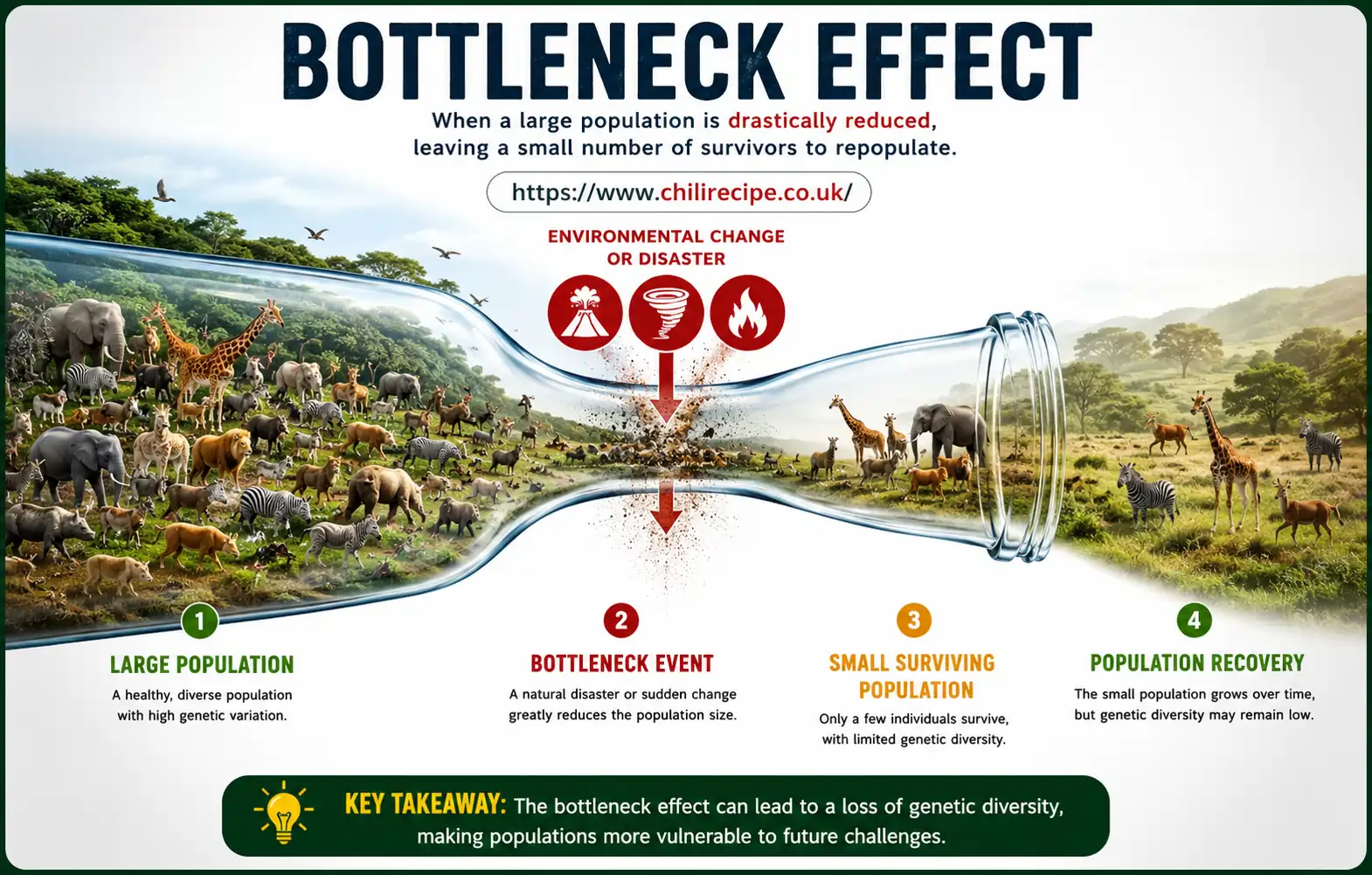
Population Shockwaves: How the Bottleneck Effect Reshapes Life Itself
A single wildfire, a brutal ice age, or a hunting spree can erase most of a species overnight. The survivors do not just get lucky; they inherit the genetic future. This drastic slashing of a population’s size, followed by a random reshuffling of genes in the few who remain, is the bottleneck effect. It violently changes the course of evolution, leaving a permanent scar on a species’ genetic code. You will see how this works in nature, human history, and even in a simple kitchen experiment.
1. The Real Bottleneck Meaning: Genetics vs. Everyday Use
We often use the word “bottleneck” to describe a traffic jam or a slow computer part. A bottleneck meaning in evolutionary biology, however, is a matter of life and death. It describes an event that drastically reduces the size of a population—killing at least 50% or more of individuals—without any regard for their genetic fitness.
This sharp reduction creates a narrow passage, much like the neck of a bottle. Only a tiny, random sample of the original genetic diversity passes through. The genes of the survivors become the entire gene pool for all future generations. The real bottleneck meaning, therefore, centers on the loss of variation, not just numbers.
The Core Mechanics
- Random Elimination: The event does not select for the “best” genes; it simply wipes out individuals based on chance location or bad luck.
- Genetic Drift: With a tiny population left, random fluctuations in gene frequencies dominate.
- Permanent Signature: Even if the population rebounds to millions, it will carry the low genetic diversity of the bottleneck survivors for thousands of years.
2. Genetic Drift’s Fast Track: The Unseen Sculptor
Natural selection is a slow, methodical editor. The bottleneck effect is a chaotic axe. This process is the most extreme form of genetic drift, a mechanism where random chance, not fitness, decides which genes survive. Imagine flipping a coin ten times; you might get eight heads purely by luck. Now imagine that coin flip decides the only eye color left in a species.
Key Differences from Natural Selection
| Feature | Natural Selection | Bottleneck Effect |
|---|---|---|
| Driver | Environmental pressure | Random catastrophe |
| Outcome | Promotes beneficial traits | Randomly fixes any trait |
| Diversity | Maintains or increases useful variation | Drastically reduces all variation |
| Speed | Slow, across generations | Instantaneous, in one generation |
The bottleneck effect proves that survival often depends on being in the right place at the right time, not on being the “fittest.”
3. Documented Disasters: History’s Most Severe Bottlenecks
Real-world events provide sobering proof of this theory. These cases show how close some species came to vanishing forever, leaving a permanent mark on their DNA.
The Northern Elephant Seal
By the 1890s, hunters had reduced the northern elephant seal to a group of fewer than 30 individuals. A single colony on a Mexican beach held the entire species. Today, the population has rebounded to over 200,000. Yet, when scientists examine their DNA, they find virtually zero genetic variation across the entire species. A single disease could still wipe them out because of this hidden weakness from their historical bottleneck effect.
The Human Toba Catastrophe
Around 74,000 years ago, the super-eruption of Mount Toba in Indonesia triggered a global volcanic winter. Genetic evidence suggests the human population may have crashed to between 3,000 and 10,000 breeding pairs. This extreme squeeze might explain why humans today have remarkably low genetic diversity compared to other primates. Our species passed through a narrow genetic gate, and we all carry the ticket stubs in our DNA.
The Cheetah’s Double Hit
Cheetahs suffered two major bottleneck events. The first occurred roughly 100,000 years ago during migration, and the second happened around 12,000 years ago during the late Pleistocene extinctions. This history left modern cheetahs with such low diversity that they can accept skin grafts from unrelated individuals without rejection. Their genetic uniformity is their greatest threat.
4. Beyond Biology: The “Bottleneck Bangs” of History
The term “bottleneck” applies to human demographics too. A specific, fascinating application you might call bottleneck bangs refers to the explosive cultural or genetic changes that emerge immediately after a population crash. It is the sudden “bang” of a new trait becoming universally fixed in a post-collapse society.
Founder Effects in Human History
- The Finnish Disease Heritage: The Finnish population went through a strong bottleneck during its settlement. As a result, a specific set of recessive diseases—rare elsewhere in the world—became common in Finland. It is a perfect example of a genetic bottleneck bang, where a limited gene pool amplified specific traits.
- Ashkenazi Jewish Populations: Certain genetic conditions, like Tay-Sachs disease, occur at higher rates in this group. Research points to a combination of a historical bottleneck and founder effects, where a small ancestral population carried these genes, and they proliferated in subsequent generations.
These human cases show how a bottleneck event doesn’t just remove diversity; it actively creates a new, homogeneous genetic landscape that can define a population for millennia.
5. The Modern Creator: Human Activity as a Bottleneck Engine
We are no longer just observers of this phenomenon; we are the primary cause. Human-driven habitat destruction, overhunting, and climate change act as relentless bottleneck triggers. When a highway cuts through a forest, it doesn’t just reduce habitat size; it fragments a single, diverse population into small, isolated pockets.
The Fragmentation Effect
- Barrier Creation: A road, city, or dam prevents gene flow between groups.
- Inbreeding Spirals: Small, trapped populations begin mating with relatives.
- Extinction Vortex: Low diversity leads to poor health, which lowers reproduction, which shrinks the population further, triggering another bottleneck.
Conservation biologists can now calculate this risk using a bottleneck calculator. This software tool analyzes DNA samples from a wild population to detect if a recent bottleneck event has occurred. By looking at allele frequency distributions, a bottleneck calculator can separate the signal of a recent crash from a long history of small population size. This data drives urgent intervention, like building wildlife corridors or translocating individuals to inject new genes.
6. The Concurrency Crisis: Understanding the K2 Bottleneck
In technology and process management, the term k2 bottleneck originates from the K2 blackpearl platform. It identifies a specific point in an automated workflow where tasks pile up because a resource cannot process them fast enough. This digital k2 bottleneck mirrors the biological principle perfectly: a single constraint limits the throughput of the entire system.
How It Mimics Population Genetics
- Limited Resources: In a population, the bottleneck is a sudden lack of living space or food. In a K2 process, it is a lack of processing threads or server memory.
- Random Failures: During a biological bottleneck, random individuals die. In a k2 bottleneck, random process instances may time out or fail based on server load, not on their logical validity.
- Performance Scars: Just as a genetic bottleneck leaves a population vulnerable, a chronic k2 bottleneck leaves a server infrastructure fragile and prone to complete failure under stress.
Resolving a k2 bottleneck requires scaling the specific constraint, just as saving a species requires expanding its habitat or connecting isolated parks.
7. Crash Course: Visualizing Genetic Loss in Real-Time
Let’s simulate a bottleneck event with a simple model using colored marbles. This visual exercise reveals why the outcome is so random.
Imagine a jar containing 50 marbles: 25 red, 15 blue, and 10 green. This is your original population with high genetic diversity (three colors).
- The Catastrophe: You randomly pour out 5 marbles into your hand. These five survivors are the only ones left to reproduce.
- Result 1: You might get 4 red and 1 blue. The green allele is permanently gone from the population.
- Result 2: You might get 3 blue and 2 red. Suddenly, blue, which was a minority, becomes the dominant color by pure chance.
Population Recovery Table
| Generation | Population Size | Dominant Color | Allele Loss | Status |
|---|---|---|---|---|
| Original | 50 | Red (50%) | None | High Diversity |
| Bottleneck | 5 | Random (Event) | Green Lost | Critical |
| Gen 1 | 20 | Red (80%) | Green Gone | Recovering |
| Gen 10 | 500 | Red (95%) | Blue Low | Large but Fragile |
The new large population never regains the original diversity unless a mutation or migration introduces a new color.
8. The Rescue Protocol: Conservation Genetics in Action
How do we save a species that has already hit a genetic wall? The bottleneck effect leaves a clear diagnostic sign: an excess of rare gene variants is lost, but the overall number of gene copies remains stable for a short time. Scientists use a bottleneck calculator to find this signal and act fast.
Triaging a Fragile Population
- Genetic Survey: Collect DNA samples from the target population.
- Computational Analysis: Run the data through a bottleneck calculator like BOTTLENECK or DIYABC. This tests for heterozygosity excess.
- Risk Assessment: If a recent bottleneck is confirmed, the species is placed on an emergency conservation track.
- Gene Flow Restoration: Build land bridges or physically swap breeding individuals between isolated parks to simulate natural gene flow.
- Cryopreservation: Freeze sperm, eggs, or embryos from genetically distinct individuals to create a future genetic rescue pool.
This protocol is not theoretical. Scientists used it on the Florida panther, introducing Texas cougars to reverse the catastrophic inbreeding depression caused by a population bottleneck.
9. Long-term Scars: Why Recovery Looks Deceptive
A population’s numbers can rebound long before its genetic health recovers. This phenomenon creates a dangerous illusion of security. A herd of 10,000 animals descended from 5 survivors might look robust, but it is a house of cards.
Invisible Vulnerabilities
- MHC Monomorphism: The Major Histocompatibility Complex is a set of genes critical for disease resistance. A bottleneck often leaves a population with a single, uniform version of these genes. A virus that figures out how to bypass this defense can kill every single individual.
- Fixed Deleterious Alleles: A harmful gene that was once rare can, by chance, become the only version in a bottlenecked population. All future offspring will suffer from the defect.
- Sperm Abnormalities: Studies on bottlenecked big cats show a massive spike in malformed sperm, directly caused by the lack of genetic variation controlling male fertility.
A census count can give a false positive. Only a genetic census using a bottleneck calculator reveals the true threat level. The bottleneck effect acts like a genetic ghost, haunting a species for hundreds of generations after the original crash.
10. Anticipating the Next Shock: Climate Instability and Survival
As the climate shifts, bottlenecks will become more frequent and severe. Floods, fires, and droughts do not kill selectively; they obliterate whole regions. Species already trapped on isolated mountain tops or fragmented reefs face a future of sequential bottleneck events.
Predictive Modeling for the Future
Scientists now combine climate models with genetic drift simulations. The goal is to predict which species will face an imminent bottleneck effect before their numbers drop. Key factors include:
- Low Dispersal Ability: Species that cannot move quickly to new habitats face a higher risk of a catastrophic bottleneck.
- Small Geographic Range: Endemic species with only one population site are one disaster away from a genetic collapse.
- Specialized Diets: If the one thing you eat goes extinct from the heat, your population will crash, triggering a severe bottleneck.
The insight from historical bottleneck bangs in human history teaches us that the post-bottleneck gene pool is unpredictable. We cannot rely on nature to sort it out; the survivors will just be random winners, not the most resilient.
Frequently Asked Questions
1. What is a simple definition of the bottleneck effect?
The bottleneck effect is a sharp reduction in a population’s size due to a random event. This causes a significant loss of genetic diversity, as the survivors’ genes become the only ones passed on to future generations.
2. How does a bottleneck calculator help conservationists?
A bottleneck calculator is a statistical program that analyzes DNA samples from a living population. It compares the observed genetic variation to what would be expected in a stable population, detecting genetic signatures of a recent crash that a simple headcount would miss.
3. Why are bottleneck bangs significant in human evolution?
A bottleneck bang describes the rapid fixation of certain genes in a human population after a drastic size reduction. When a population rebounds from a small group, specific traits that were present in the founders can become universally common very quickly, shaping disease risk and physical traits for millennia.
4. What causes a k2 bottleneck in a workflow process?
A k2 bottleneck happens when a specific step in an automated workflow receives more items than its allocated resources can process. This constraint slows down the entire process chain, similar to how a narrow pipe restricts water flow, causing a backup of pending tasks.
5. How does the bottleneck effect differ from the founder effect?
The bottleneck effect and founder effect both reduce genetic variation, but the context differs. A bottleneck randomly kills most of an existing large population. The founder effect occurs when a few individuals voluntarily leave a population to start a new colony, carrying a non-random subset of the original genes.
6. Can a species fully recover from a genetic bottleneck?
A species can recover its population size, but it never fully regains its original genetic diversity through natural means alone. The lost alleles are permanently gone unless they reappear through very slow mutation or human-assisted gene flow from a different population.
Securing the Genetic Future
Genetic diversity is a species’ armor against an unpredictable world. The bottleneck effect strips that armor away, leaving a raw, vulnerable biological core. You can see its signature in the uniform fur of a cheetah, the silent genes of a human cell, and the failing processes of a digital server. Ignoring the warning signs—whether in a wildlife reserve or a complex K2 system—leads to a predictable collapse.